
Real County Bench Warrants Explained
People say "bench warrant" whenever a court acts after someone misses a setting or ignores a court order. In a Real County justice or municipal case, Texas Chapter 45A controls the key steps. A citation left unresolved can turn into a failure to appear or some other court action. That sequence is not automatic. The issuing judge reads the record and decides what comes next. Money changes things too. An unpaid final judgment can produce a capias pro fine, which is not the same as a new probable-cause arrest warrant. Ask the Real County clerk to name the exact process on your file instead of settling for a loose label like "traffic warrant," because the remedy you need depends on which one it is.
Real County JP Labels and Bench Warrants
Real County labels are messy right now. The county election page shows one countywide Justice of the Peace position, yet the official nCourt pages still read "JP 1&2" for Leakey and "JP 3&4" for Camp Wood, and an OCA verification also lists a countywide setup. Those labels do not line up on one clean precinct map. So trust the court printed on your citation. Do not pick a portal just because it matches your town. If the label on your paper differs from the county election listing, call the court and ask whether the older portal still handles that case. The county officeholder page linked here is the current public JP listing for Real County.
How Real County Bench Warrants Are Issued
A missed appearance can be recorded as a failure to appear. From there, a Real County court may issue a warrant or capias, set a new date, or order another remedy that fits the law and the facts. When a final fine sits unpaid, the court may consider a capias pro fine under Chapter 45A. None of this happens on its own. A glitch in a payment portal does not trigger court process. A qualifying FTA or failure-to-pay matter can also be reported for a DPS license-renewal hold, and that report runs on a separate track from the court's warrant process. The Real County court decides whether process exists at all, and only that court can confirm whether a warrant stands recalled or satisfied today.
Real County Bench Search Uses Case Numbers
The Leakey JP 1&2 nCourt page searches by Citation/Ticket Number or Case/Cause Number through one number field. It lists (830) 232-6630 and asks for five days before online payment. If a number fails, retry it without the leading zero. The official Leakey JP number-search workflow carries no warrant-status field for Real County cases.
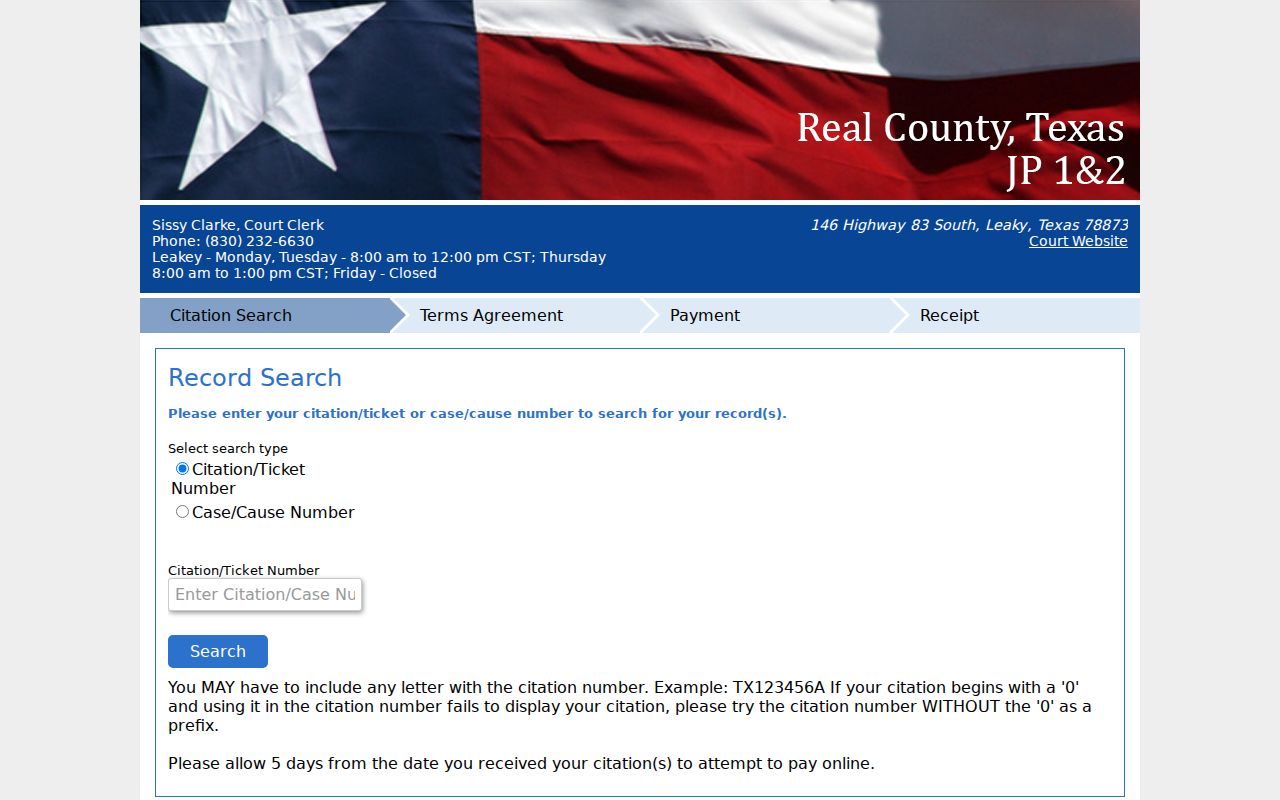
Use that number search only when your citation matches this court label. The Real County JP clerk can say whether a separate appearance is required.
Bench Warrants and Arrest Warrants Compared
These labels mark different paths. A bench warrant concerns a missed setting in an existing court case. An arrest warrant generally follows a probable-cause process for an alleged offense. Your paperwork tells you which one applies. See the Real County arrest warrant search for Chapter 15 and service details.
| Point | Bench or FTA process | Arrest warrant |
|---|---|---|
| Common trigger | Missed setting or failure to comply | Probable cause for an alleged offense |
| Issuing authority | The court handling the existing matter | A magistrate under Chapter 15 |
| Possible related term | FTA, capias, or capias pro fine | Arrest warrant |
| Who confirms status | The court named on the notice | The issuing court, with agency routing as needed |
Real County Payment Does Not Recall Warrants
The nCourt pages walk you through terms, payment, and a receipt. No page shows a "recall warrant" button, a bond field, or a court-order upload. A receipt proves a transaction happened. It does not prove the court's separate recall action. Ask the Real County clerk what must follow payment and how the court will confirm the result. The Camp Wood JP3&4 nCourt page offers the same basic number choices, though its clerk contact and hours differ, and its number-entry workflow appears with this section.
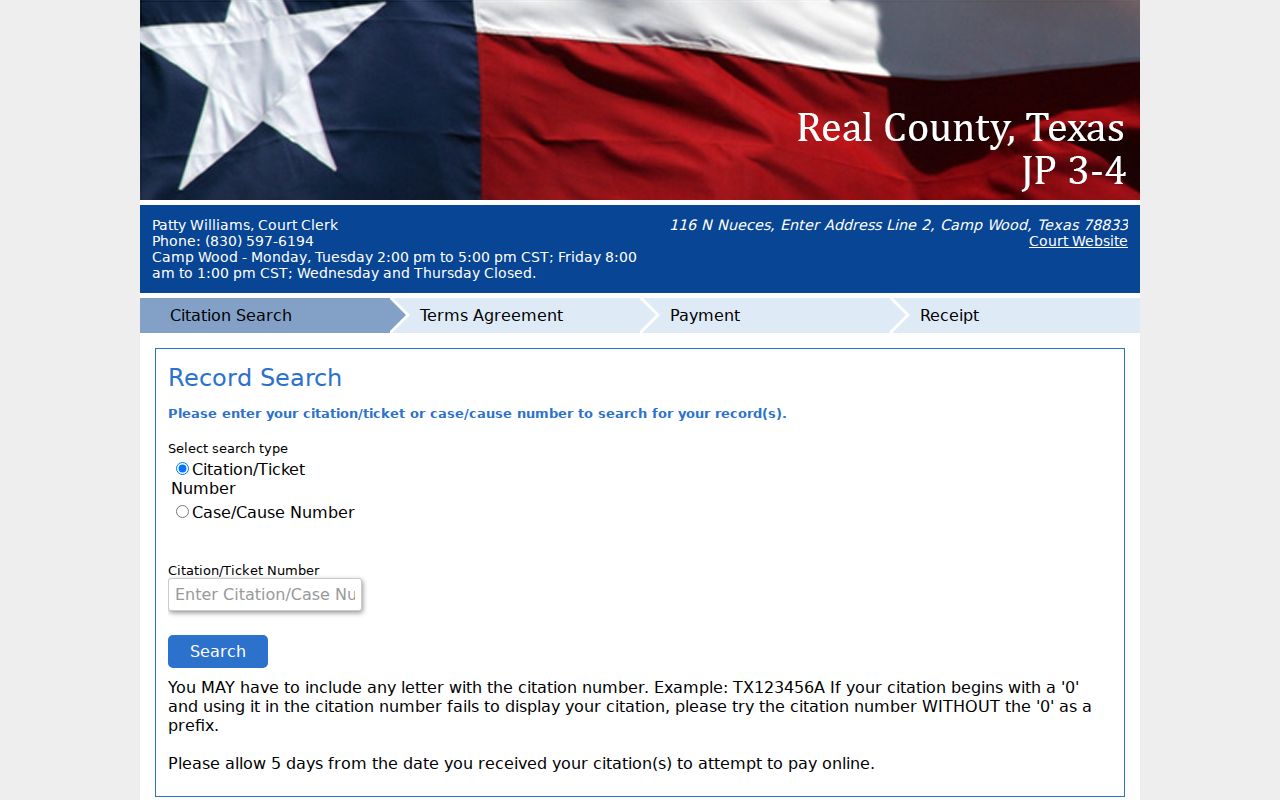
That portal lists (830) 597-6194, open Monday and Tuesday afternoons plus Friday mornings. Confirm the current Real County court label before relying on an older paper.
Resolving a Real County Bench Warrant
Call the issuing court before you pay, travel, or show up voluntarily. Ask whether the file is still a citation, an FTA, a capias, or a capias pro fine, and whether a new setting or a lawyer is needed. Texas law says an applicable FTA arrest warrant must be recalled when the defendant voluntarily appears, or makes a good-faith effort to appear, before execution, subject to its conditions. The Real County court controls how that step gets arranged.
- Match the court name and number on the notice to the clerk or portal.
- Ask whether the warrant is active and whether voluntary appearance, recall, or a new setting is available.
- Confirm any payment, plan, community-service, bond, or indigency option with the court.
- Get a receipt or written confirmation and ask whether another court date remains.
Caution: Do not assume an online payment cleared the warrant; ask the issuing court to confirm the recall and any remaining appearance date.
Real County Warrant Search Date Limits
The iDocket filing-status page carries a Real County filing date of September 15, 2026 and a district filing date of September 14, 2026. Those dates only show electronic filing was active. They say nothing about whether one person's warrant was served, recalled, or still open. The official filing-status dashboard is a date view, while the public iDocket form works as a case-search route. Take any current process question to the court itself.
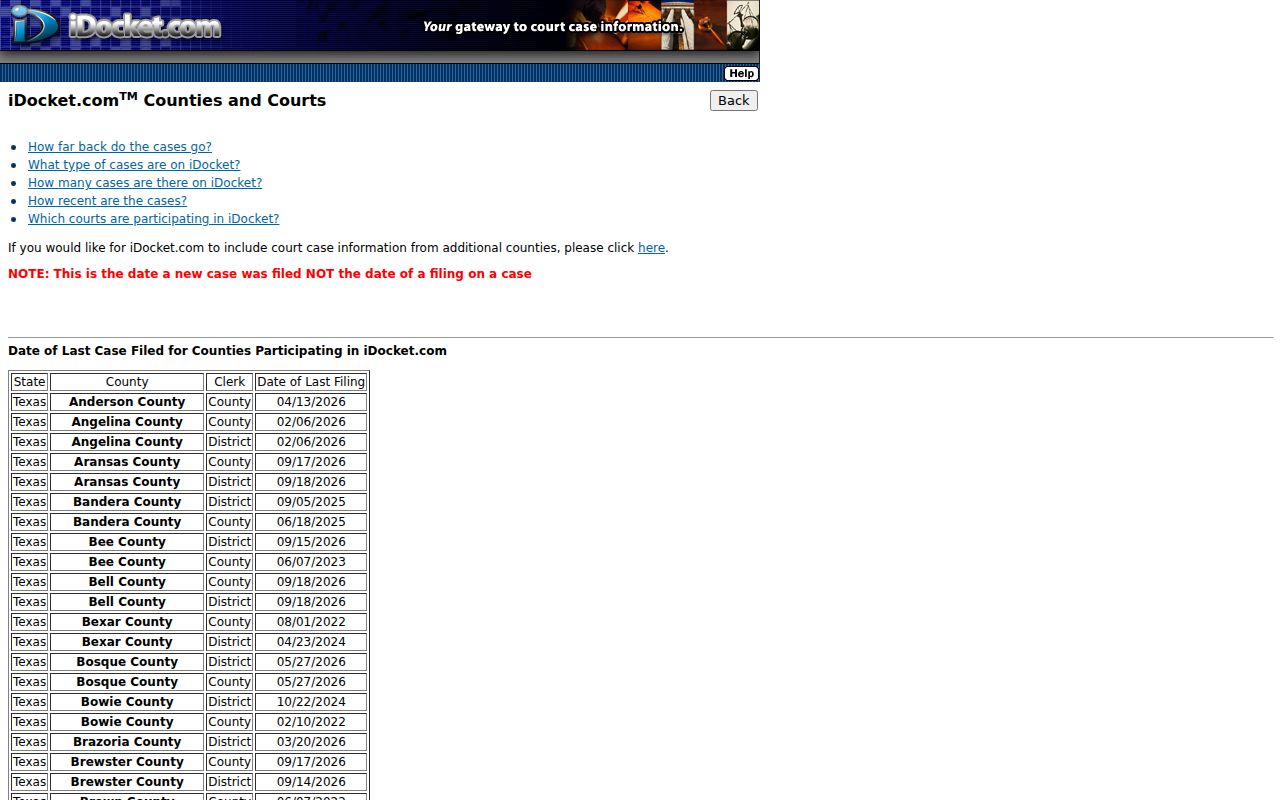
A filing date signals system activity in Real County, not a warrant count or a clearance result.
Finding the Real County Warrant Court
Start with the paper in your hand. The citation shows which Real County court holds the case. A JP traffic matter carries its printed JP label, a municipal citation belongs to that city's court clerk, and a district criminal matter routes through the 38th Judicial District Court and the combined County/District Clerk. One clerk phone serves county and district records, so name the court and case type when you call. The official iDocket search help walks through the number fields and the subscriber limits on the state's public search.

Nothing in the public index? Call the court named on the paper, or ask the sheriff to route the question to the right Real County office. The Real County warrant records overview gathers the local contacts.
Real County Warrants and FTA Holds
Miss court in Real County, and Texas DPS can block a driver's-license renewal. That happens when a participating court reports a failure to appear or a failure to satisfy a judgment. DPS never sets the terms. The reporting court names the fine, the appearance, the plan, or the service option it will accept. Updates generally take three to five business days after the court reports a resolution. One caution applies. A license hold is not proof of a separate arrest warrant. A cleared hold does not prove a Real County warrant was recalled either. For the reporting and renewal question alone, contact DPS or OmniBase. The Texas DPS FTA/FTP information page describes the state program and points every question back to the reporting court.